Microsoft Australia

Feedback Form

SERVICE DESIGN
UI DESIGN

Scroll down to learn more

SUMMARY

Microsoft Australia customers found it difficult to request assistance for a problem, with some choosing to message the Managing Director via LinkedIn.

A band-aid approach was designed to promote the support phone number via owned assets and paid search, and an escalation website was created to enhance the branch walk-in experience.

PROJECT TIMEFRAME

Ongoing across six months alongside other work commitments.

RESPONSIBILITIES

My responsibilities included:

User scenario testing to understand the customer perspective

Creating a user flow of the complaint submission process

Designing the escalation website interface

Coding the escalation website interface using PHP, HTML, CSS

Analysing customer complaint feedback data

INTERESTING FACT

Some frustrated customers would drive long distances to the Microsoft Office (North Ryde) to have their voice heard. People from around the world would submit escalation tickets to Australia for assistance.

1
EMPATHY
  • Surveyed 3,000+ support customers to ask how they found the support number
  • Google Keywords Analytics to determine what key terms people are using to search for support
2
DEFINE
  • User scenario testing to map out possible user journeys from the Microsoft homepage to the support number
  • Mini customer journeys to identify how customers complain to Microsoft Australia (face-to-face)
3
IDEATE

SUPPORT NUMBER PROMOTION

  • Identified key terms for Bing and Google to promote the support number
  • Specified URLs for Microsoft US to add the support number

ESCALATION WEBSITE

  • Identified form fields for escalation
4
PROTOTYPE

SUPPORT NUMBER PROMOTION

  • Sent update requests to Google and Bing to promote the support number on selected key terms
  • Sent update requests to the Microsoft US

ESCALATION WEBSITE

  • Creating escalation website hosted on Microsoft Azure, coded using PHP, HTML, CSS
5
TESTING
  • Review of website analytics
  • Feedback calls with the support team
Customer Support Survey
Google Keyword Analysis
Interviews

Customer Support Survey

To research how customers found the support number, a survey was sent to over 3,000 customers who recently received support. When asked how they found the support number, almost 50% of respondents used Microsoft.com, followed by Google search.


Google Keyword Analysis

Working with our social media contacts, we found the top 20 Google search terms that people for Microsoft Support. The top five were compared to the previous year using Google Trends, to identify if they were consistent trends or outliers.


Interviews

It was decided not to rely on online avenues for customer complaints. The reception team at Microsoft Office (2 persons) were interviewed to understand how people make their complaints elsewhere. An interesting insight was that some people choose to escalate their support tickets by messaging the Senior Leadership Team via LinkedIn or driving over to the North Ryde office for assistance.

User Stories
User Scenario Testing
Customer Journey

User Stories

After research analysis and discussions with the leadership team, it was decided that the focus would be on promoting the support number via owned assets and search and enhancing the branch walk-in experience so customers can escalate their support tickets effectively.

USER STORY #1

As a customer, I want to be able to find the support number so that I can easily file a support ticket with minimal effort.

USER STORY #2

As a customer, I want to be able to escalate my support ticket so that I can resolve my issue in a timely manner with minimal frustration.


User Scenario Testing

User scenario testing was implemented to better understand the customer's perspective and how they can find the support number via Microsoft.com. From this test, it was discovered there were two main destinations where the support number was missing:

CONTACT US - AUSTRALIA

This page included the details to the Head Office location but no support number was listed.

MICROSOFT AUSTRALIA - OFFICE LOCATIONS

This page listed the addresses of each of the offices across the Australia, and it was envisioned that the customer would be trying to contact the offices directly to escalate their request.


Customer Journey

Working alongside the Customer and Partner Engagement Team, Customer Support Team and Reception Team, the user journey for a customer trying to escalate a support ticket. After a verbal ideation session, it was decided that the best way to escalate support tickets would be through a web form.

Support Number Promotion
Escalation Website

Support Number Promotion

Working with the Google contact for Microsoft, it was decided that the best way to give prominence to the support number was to have it in large font under the sponsored ads. The support number would appear in the commonly used search terms such as Microsoft Support, Microsoft Australia, Microsoft Support Number, etc.

It was also decided that it would be geo-targeted so that the Australian Support number would display if you search for Microsoft support on google.com.au or on an Australian IP address.


Escalation Website

For the escalation website, the form fields were planned into a database table. This allowed us to identify the data to be recorded and determine which fields would be valuable to the Customer Engagement Team and Customer Support Team.

Support Number Promotion
- Microsoft.com Website
- Google
- Bing
Escalation Website

Support Number Promotion

Working with the website development teams, the changes to the Support Number being more visible were implemented.

Microsoft Australia - Office Locations

For the 'Office Locations' page, the recommendation was to add the support number under each address of the different offices.

Google

Working with Google, the support number was given prominence for the top 10 search terms.

Bing

Similarly, the number was also given prominence on Bing, as it is owned by Microsoft.


Escalation Website

The first version of the escalation web form was built using HTML and CSS and hosted on Microsoft Azure. The back-end database was accessible to the Support Team and Reception Team, with a dedicated Support Team member to triage the submissions.

Data Analysis
Escalation Website

Data Analysis

After twelve months, the number of submissions increased, however, the web form effectively captured the data. After re-interviewing the affected Senior Leadership Team and reception, it was discovered that the number of escalations requests via LinkedIn and walk-ins had dramatically decreased.

Upon review from the Support Team, it was identified that amongst a large number of complaints, some people were trying to make new support requests without calling the support number. Also, it was identified that people also used the form to submit compliments and product feedback suggestions, such as how to improve Windows 10.


Escalation Website

The logic of the web form was revised so that first-time customers could instead book a follow-up call at their desired time. It also included a question to identify which.

View larger image of flowchart

The website aesthetic was updated as well to reflect a more modern look to match the Microsoft Brand Guidelines.

Landing Screen

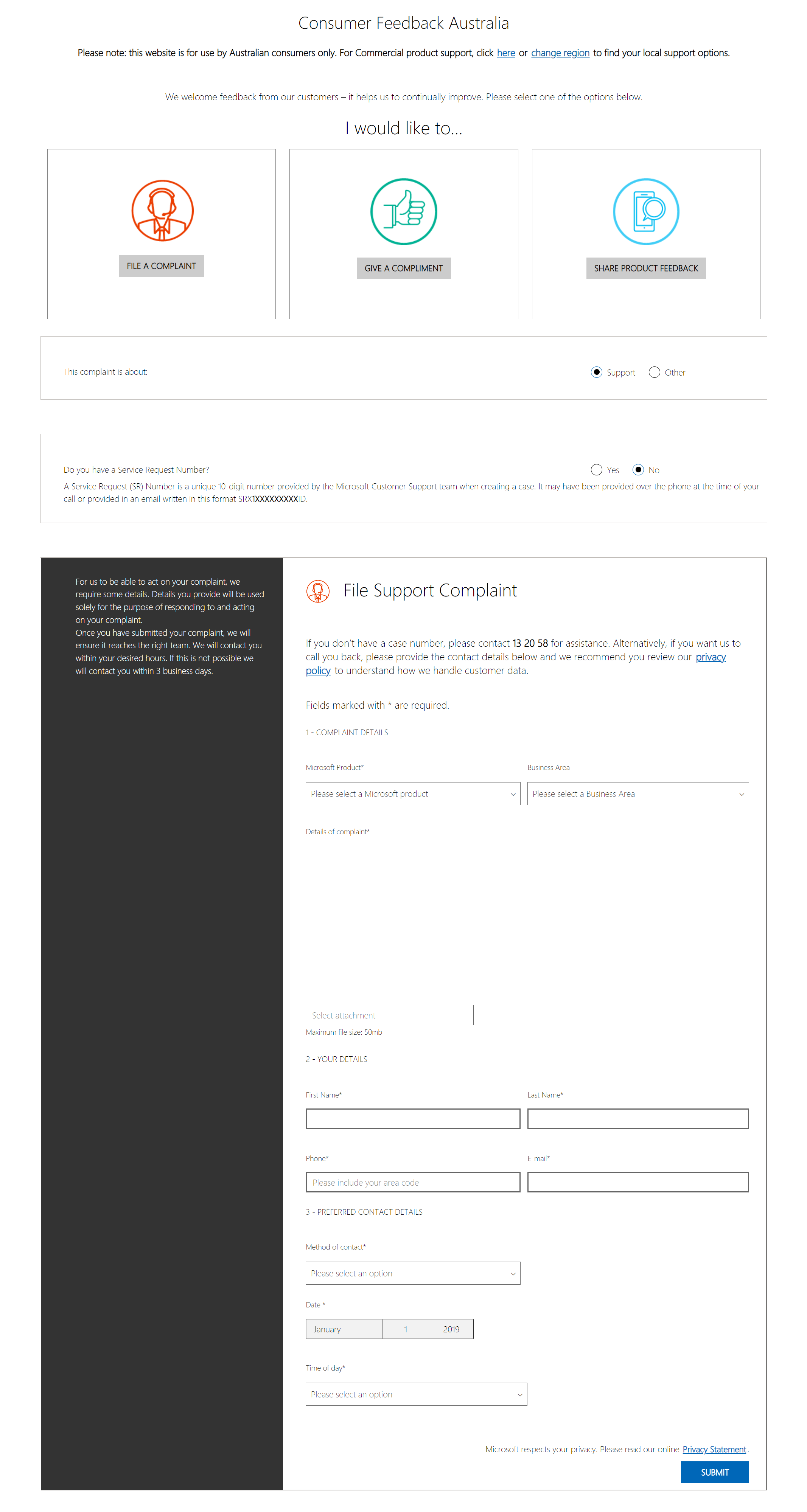
The user is met with three choices: Complaint, Compliment, or Product Feedback. This allows the support team to filter their inquiries. There are also links to change the region or receive commercial support just in case those users land on this page.

Complaint > Support > Has Service Request Number

For support complaints, an extra step has been added to filter those with or without service request numbers (SRN). For those who provide the SRN, the system also verifies that it follows the correct structure to prevent spoofing. The user is also asked for their preferred method of contact, and if they select phone, they are also asked to provide an appropriate callback time. This filtering method allows submissions on this form to be given the highest priority.

Complaint > Support > Has No Service Request Number

This form version has been added as many people used fake SRNs to try to get in contact with Microsoft Australia Support. Similar to the previous form, users are asked for their preferred method of contact and callback details if the phone is selected. In the back end, the system creates a new ticket for the support team to handle the case.

Complaint > Other

For all other complaints, users can provide feedback; however, this is treated with a medium level of priority, so contact details are limited to e-mail, without the expectation that Microsoft will contact them in return.

Compliment > Support

For those who wish to give their thanks, they can complete a separate compliment form. The Microsoft Product field remains in the form to redirected the feedback to the relevant team. The user is also able to request further contact. However, this has been hidden via a checkbox to prevent the support team from contacting too many low-priority cases.

Compliment > Other

Similar to the previous form, users can provide their compliments without an SRN and request further contact.

Product Feedback

Product Feedback is a separate form, as the data had shown that some people wanted to have their voice heard and were willing to submit a fake SRN to provide their product feedback. The support team reviews the feedback, and if approved, it is forwarded to the relevant product owner on a monthly basis.


Goals achieved

The original goal of this project was to promote the support phone number across owned assets such as the Microsoft website and Microsoft social media channels.

Through analysis of the user experience at the time, it was discovered that the issue was that those seeking support felt they needed to be heard rather than they couldn't find the support number.

By working with the US and Australian customer support teams, and our design and development agency overseas, the goal has been achieved as we have created a portal allowing customers seeking an escalation of support to share their voice.

Lessons learnt
  • No matter how much quantitative data is available, the user experience remains unknown if you don’t have the thoughts and opinions of the users to formulate an idea
  • Set data reviews earlier in the project instead of waiting for six months of collection of data
  • Test process flows with actual end-users for more accurate results instead of persona role-plays
Experience gained
  • Working with various stakeholders, including: Head Office corporate in the US, the design and development team overseas, the local customer support team
  • Negotiating solutions when notified of limitations to website design
  • Coding solutions to adhere to visual design guidelines

Liked this project? View more more below:

Onboarding Re-design

This was a week sprint followed by ongoing changes at Standards Australia to redesign the new starter experience so that they could be comfortable starting work from day one.

View project

Caring for Carers

This was a 2-week project working with Chris O'Brien Lifehouse to identify different ways of how to improve the website for current and future visitors of the cancer speciality centre.

View project

Beat.Box Project

This was a six-week project for the part-time Visual Design class at General Assembly. The objective was to promote a new music streaming service called "Beat.Box".

View project (PDF)

If you have any questions,
please feel free to reach out: